A Big Fish Expeditions Trip Report
By BFE Trip Leader Julian Gunther
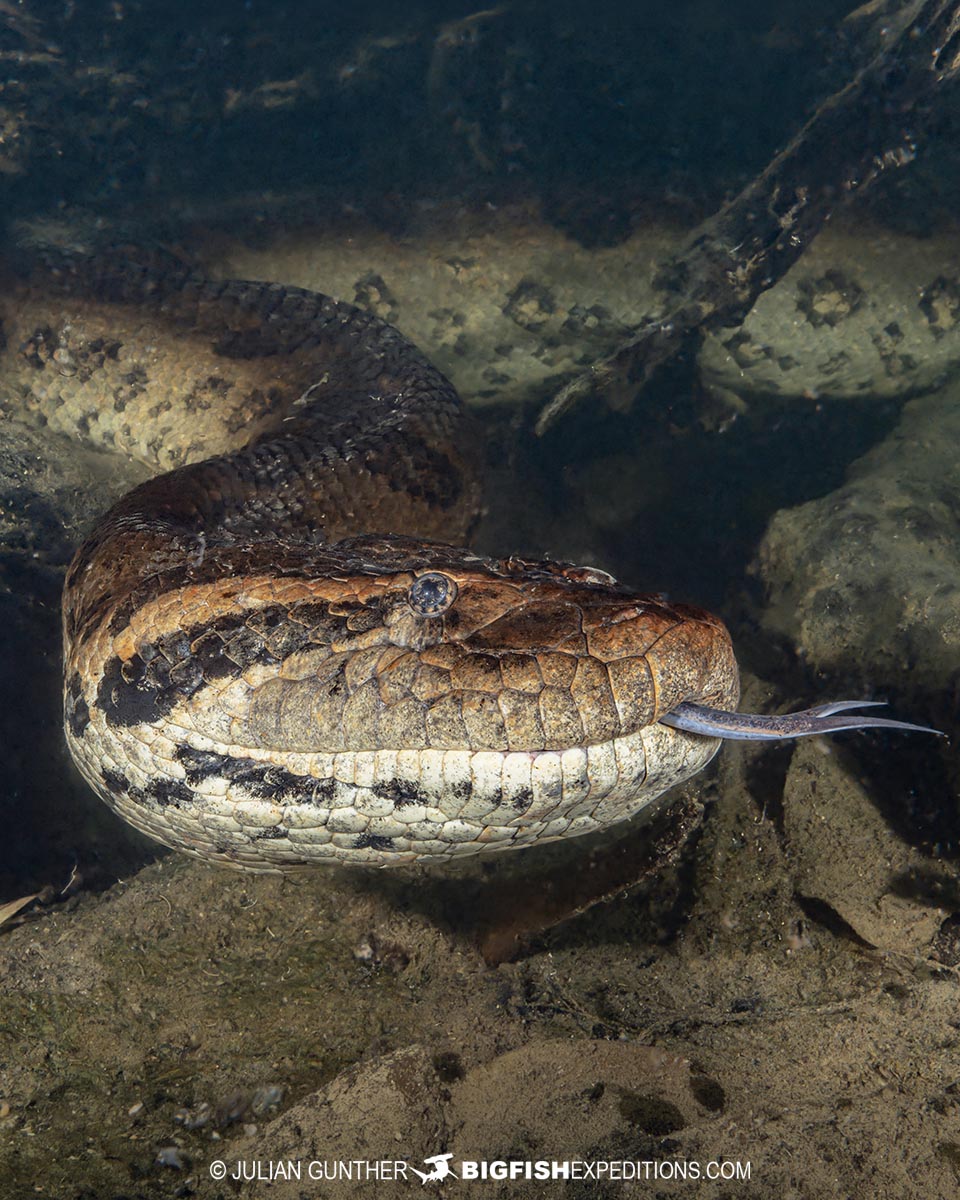
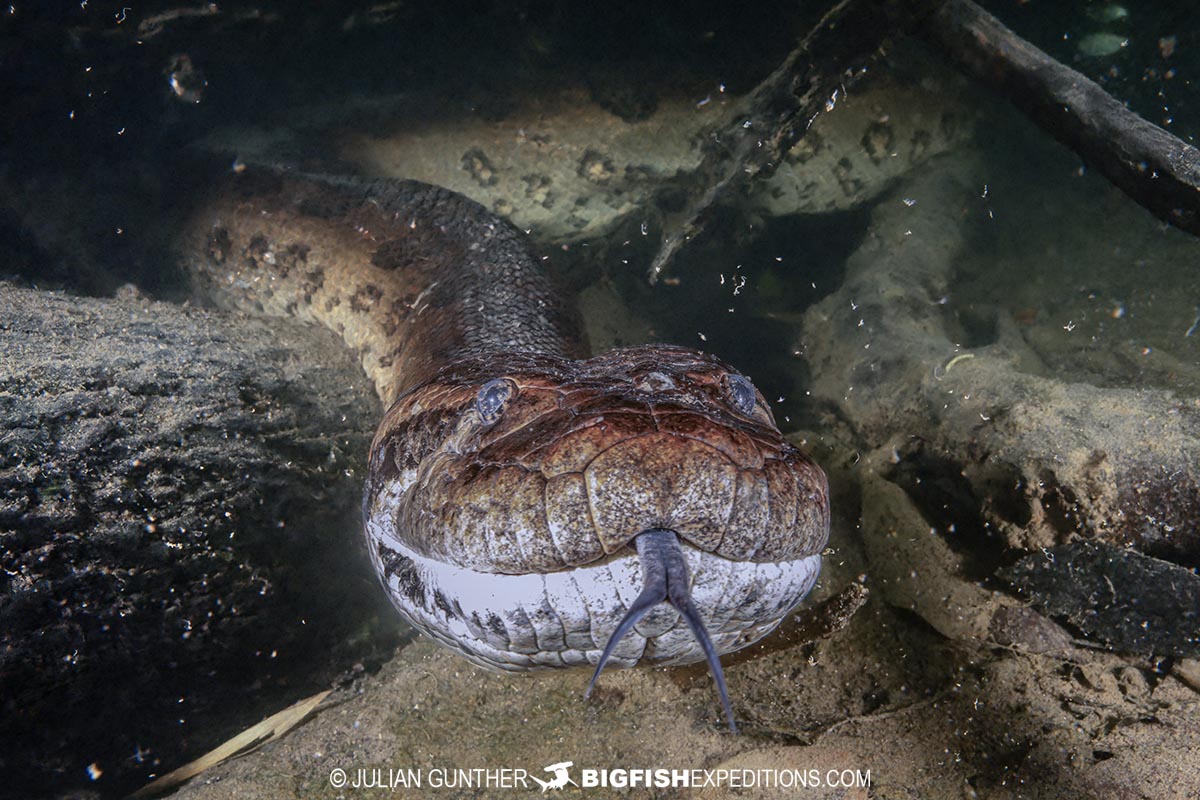
Anacondas can be found throughout Brazil and much of northern South America; however, it is only in the area around Bonito in Mato Grosso do Sul that they can be found in relatively clear rivers with frequent reliability. For this reason, Big Fish Expeditions returns every August or September to this quiet part of the Pantanal to dive with the king of the snakes.
After completing the long journey to Bonito, we went to our dive operator’s offices for a briefing on what to expect over the coming days, as well as an examination of anaconda skulls and skeletons. Our photographers examined the replicas, and by the look in their eyes, it was obvious some were reassessing their decision to dive into water with a reptile of this size! At the conclusion of our briefing, we were given some good news: a mating ball had been sighted nearby and consistently observed over the past two days. We would be heading straight for it first thing the next morning.
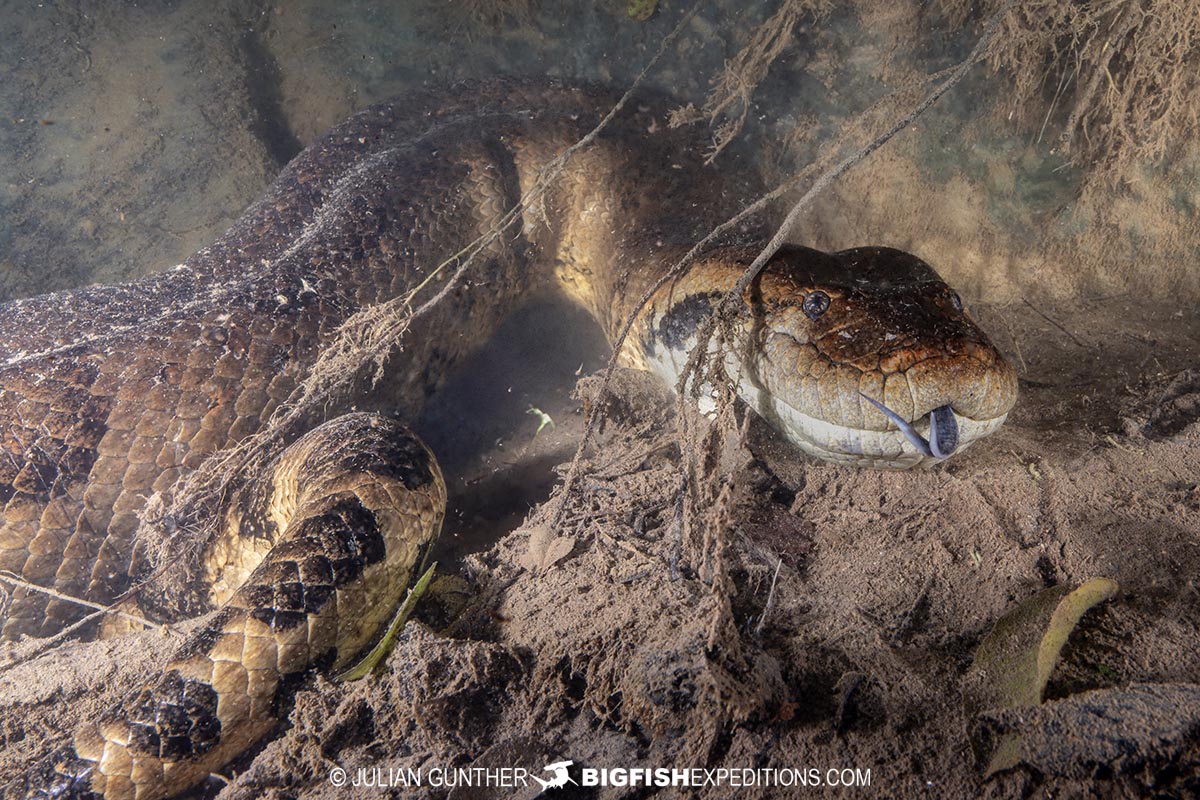
As promised, the following morning we went straight to a pond-like area in the river where the mating ball had been reported. One of our guides immediately spotted two snakes on the far shore, albeit hidden under dense brush. We slowly made our way across the river so as not to disturb them. Normally, snakes engaged in mating are distracted enough that noise is a non-issue; however, these snakes were easily spooked. The larger female immediately dove into
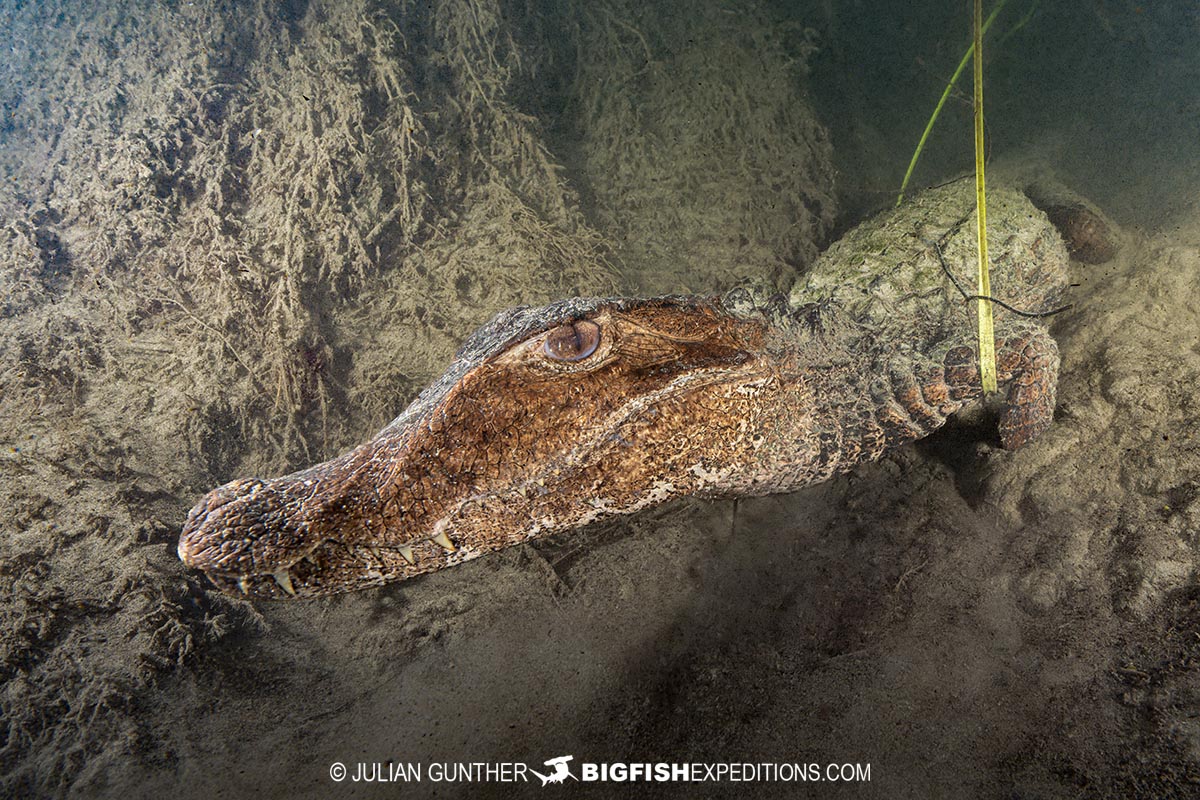
her den, while the smaller male managed to scoot through roots and fallen logs, escaping largely unseen—except by one of our photographers who was fortuitously positioned and captured video of the fleeing male as it swam past. We waited and hoped they would return, but eventually accepted they were gone and headed to a nearby river that had also reported sightings over the previous days. This second location was a narrow waterway winding through dense jungle and farm pastures. As we headed downstream, everyone kept a watchful eye, hoping to catch a glimpse of the reticulated pattern or large head characteristic of an anaconda. After a thorough search yielded nothing, one of the guides spotted something beneath some fallen branches: a Cuvier’s Dwarf Caiman!
These small crocodilians are relatively common in the Pantanal’s rivers, and we immediately started taking photos and
videos. It rested on a shallow river slope, making for some interesting body positioning. As an added bonus, none of our photographers had ever been in the water with a crocodilian before, making this an epic find.
After getting our fill of the little caiman, we continued our journey. Another hour of searching brought us around a slight bend where a guide spotted a head peeking out from the reeds—success! This was an approximately four-to-five-meter anaconda with just its head exposed from its den. We entered the water and tried to cross the river, but the ripping current made it challenging. Several photographers caught sight of the snake underwater as it emerged slightly from its burrow for a closer look, only to quickly retreat and offer a teasing glimpse of what was still to come for the week. Two sightings on the first day is not a bad start, but we wanted more. As the sun descended and the biting flies came out, we realized it was time to head home for both photographers and batteries to recharge.
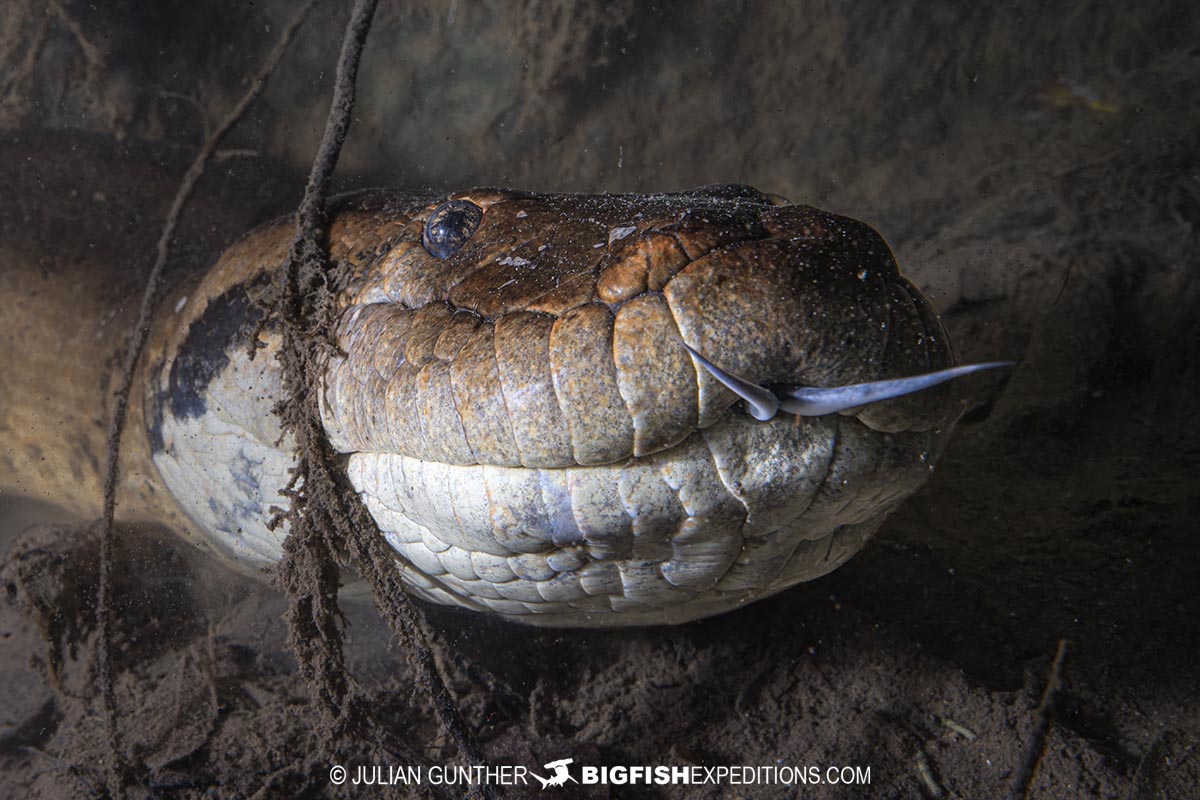
Our second day started much like the first, with weather conditions favorable for snake sightings. We headed to a new stretch of river, launching near Praia da Figueira along the Rio Formoso—a clear waterway lined with trees and natural slips providing ideal spots for animals to drink and anacondas to lay in ambush. As we drifted downstream, we kept a close lookout.
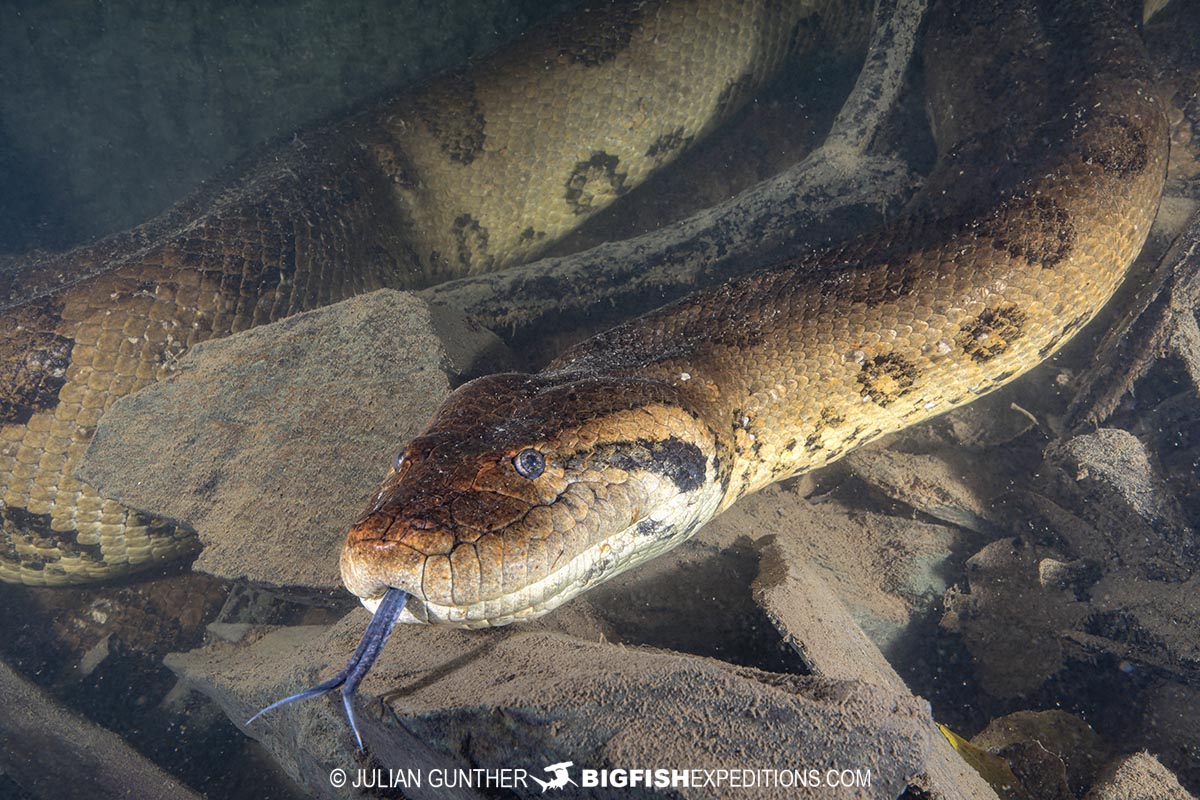
After about 90 minutes, a guide signaled he had found one! It was a five-to-six-meter individual perfectly camouflaged on the far side of a river island. Unfortunately, access wasn’t easy; we had to navigate a strong current and large rocks. By the time we reached the snake, it had already caught on to our presence and began retreating toward the safety of a nearby waterfall and tunnel system. All photographers caught a surface view of the reptile as it slipped away, and their dropped jaws and wide eyes spoke louder than words—these are big snakes. We waited to see if it would exit, but alas, it wasn’t in the mood, so we decided to continue downriver.
Another 90 minutes passed before another guide spotted what he thought was the telltale reticulated pattern of a large anaconda. In comical fashion, a fellow guide went to verify, initially claiming it was just a fallen log, followed immediately by an exclamation: Oh, wait, it’s behind the log! Yep, it’s here, and it’s big! Navigating this sighting was challenging since the animal was positioned behind a shallow sandbar and wrapped inside fallen logs. We did our
best to get into position, inevitably kicking up a bit of sediment in the shallow water. Even so, everyone managed to snap some shots before the snake retreated beneath the river overhang into a maze of roots and tunnels. At this point, everyone was energized—we had spotted two anacondas and were only just breaking for lunch. Little did we know what awaited us a few hours later.
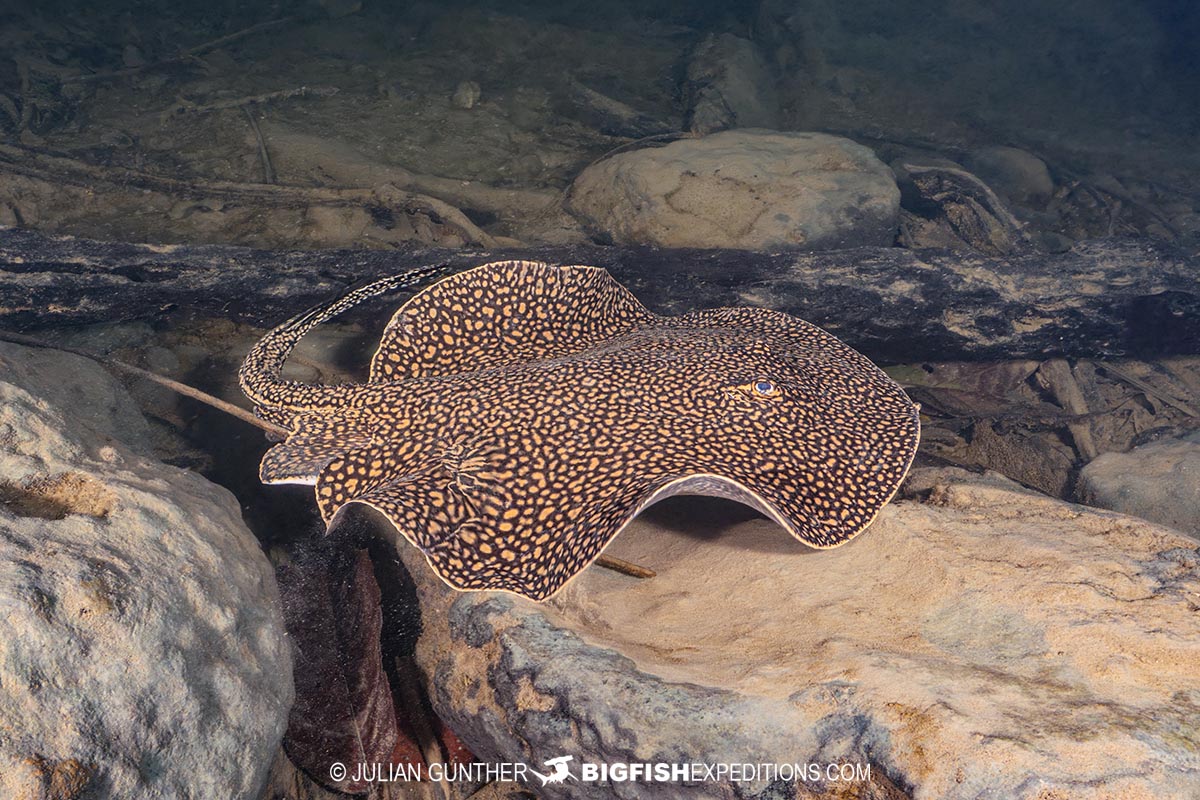
We resumed our journey downriver after lunch, noticing an increasing number of freshwater stingrays, particularly large numbers of Largespot River Stingrays. We hopped into the shallows to capture footage of these colorful rays.
Rounding a deep river depression and bend, one of our guides called out: another anaconda, and this one was big! It rested in the water, partially obscured by a small island and sandbar. When our initial approach drove it into the river’s depths, a guide and I donned scuba gear to search the riverbed. We scoured the murky channel and quickly got separated. As I searched the deep channel, something large and dark materialized out of the gloom—a two-meter (6.5-foot) Yacare Caiman resting on the riverbed, followed immediately by a second, smaller one right behind it!
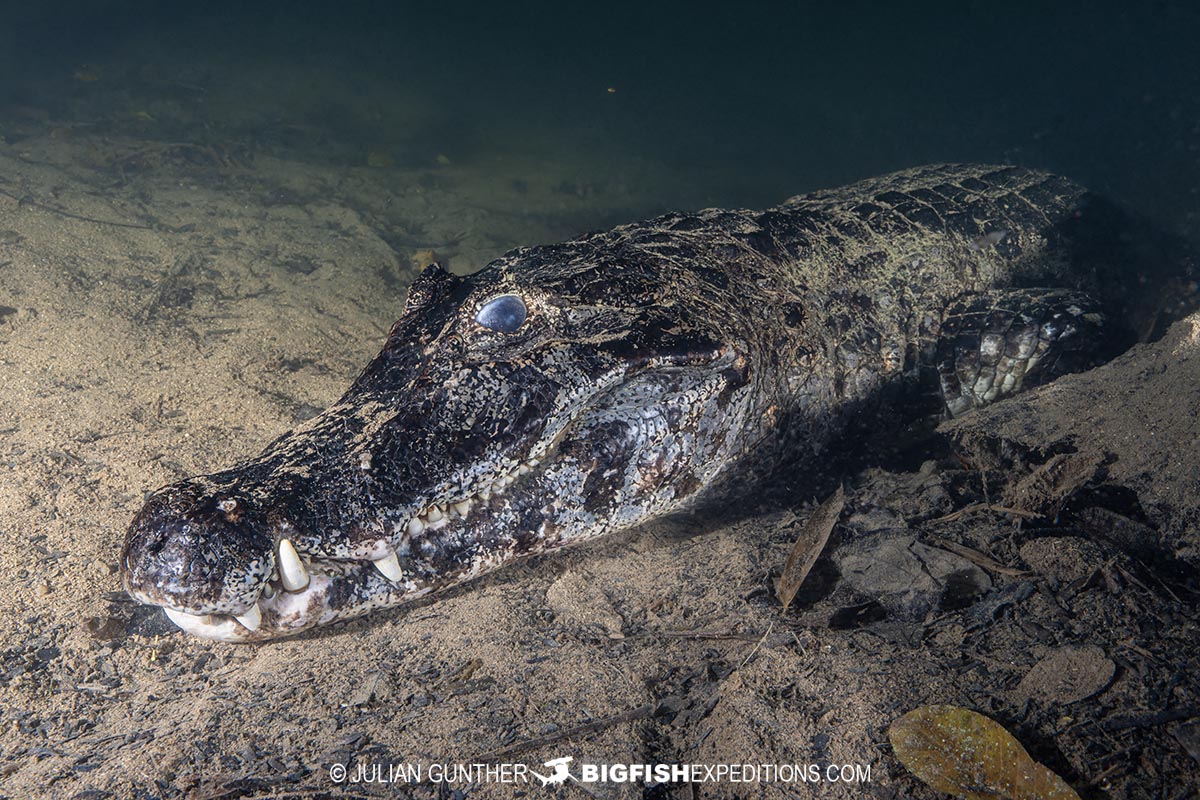
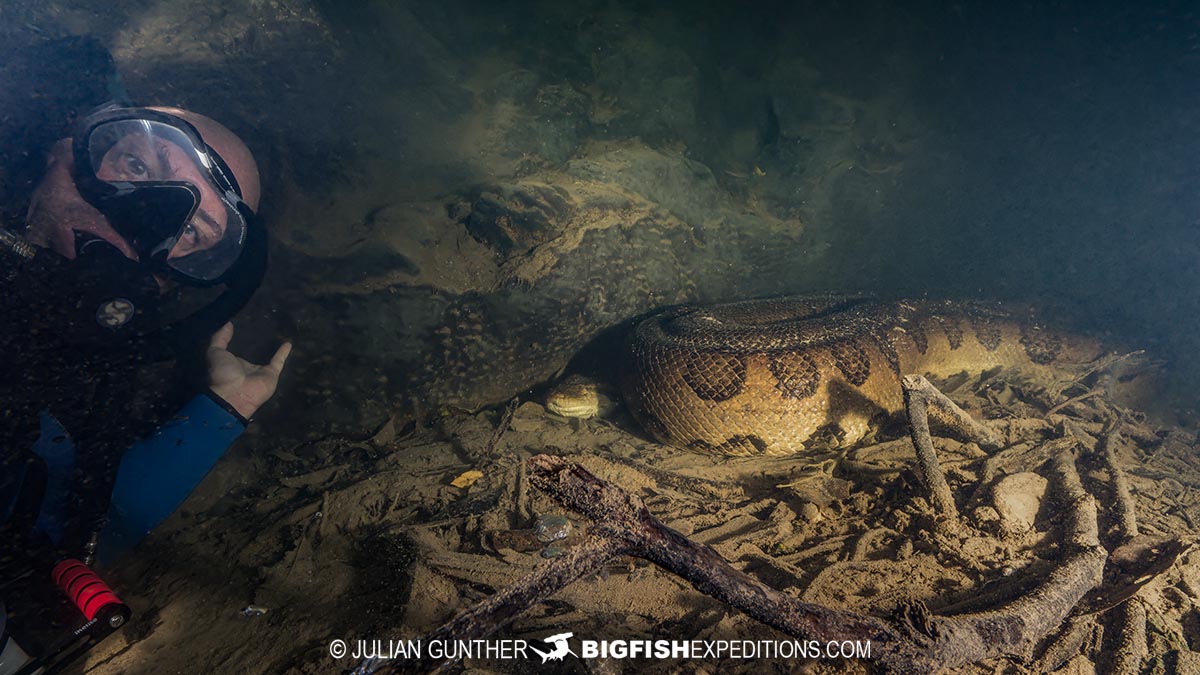
Unsuccessful in finding the snake underwater, I surfaced to alert the guide and guests about the caimans, only to discover they had already found the snake! It was a six-to-seven-meter giant settled and had peacefully into the riverbed, posing for photos. The river gods truly smiled on us that day, as sitting within visual distance of the anaconda were the two Yacare Caiman. We alternated between photographing the anaconda and the caiman at our leisure. The two sets of reptiles remained largely unbothered by our presence, and we snapped away until a metal rod
banging against the boat above signaled it was time to depart. We easily could have stayed another hour or more with these river denizens, but we needed to reach our departure point before nightfall. It was a day for the ages!
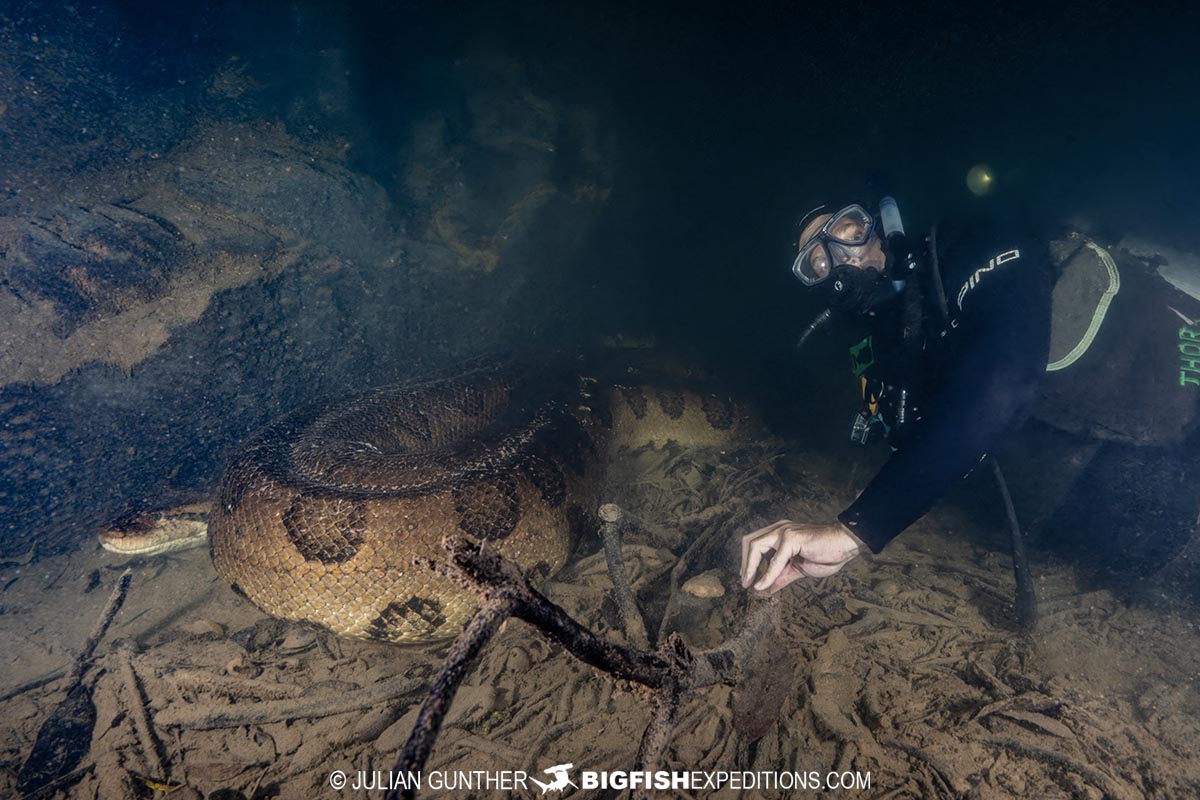
After two phenomenal days, our expectations for day three were sky-high. We entered the Rio Formoso at a location surrounded by small waterfalls and river rapids. At the boat launch before we even finished loading, a guide called out that he had already found a snake. Sure enough, he led us to a two-to-three-meter anaconda coiled within a dense patch of reeds. It appeared to have recently eaten and was hiding to digest its meal. Because of its positioning near the edge of a waterfall, optimal photography angles were limited, but we secured solid proof of life shots.
Once everyone observed the snake, we left it undisturbed and continued downriver. Unfortunately, the weather turned, bringing a slightly chilly wind and overcast skies—less than ideal conditions for reptile viewing. Still, having started the morning with a sighting, we pressed on. While that ended up being our only snake of the day, as one guest
aptly noted, Yesterday was beyond expectations, and we are still in the Pantanal on this beautiful river looking for anacondas!
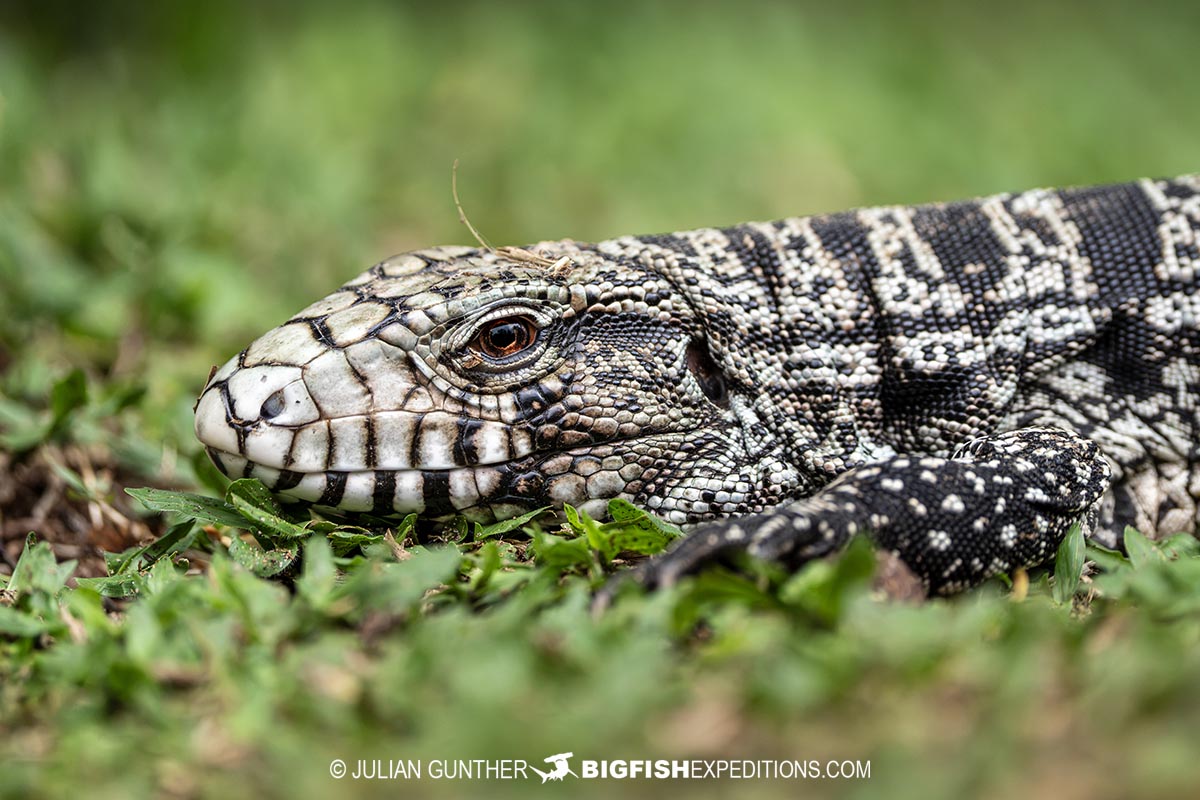
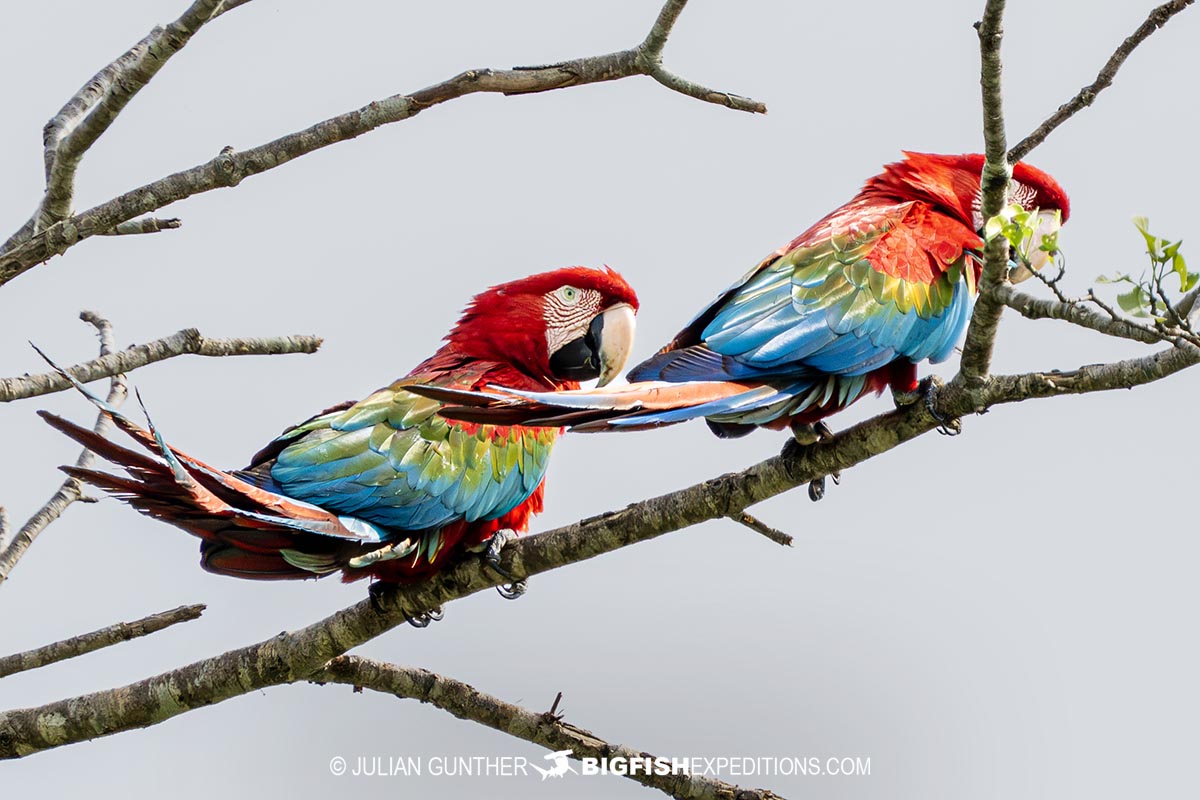
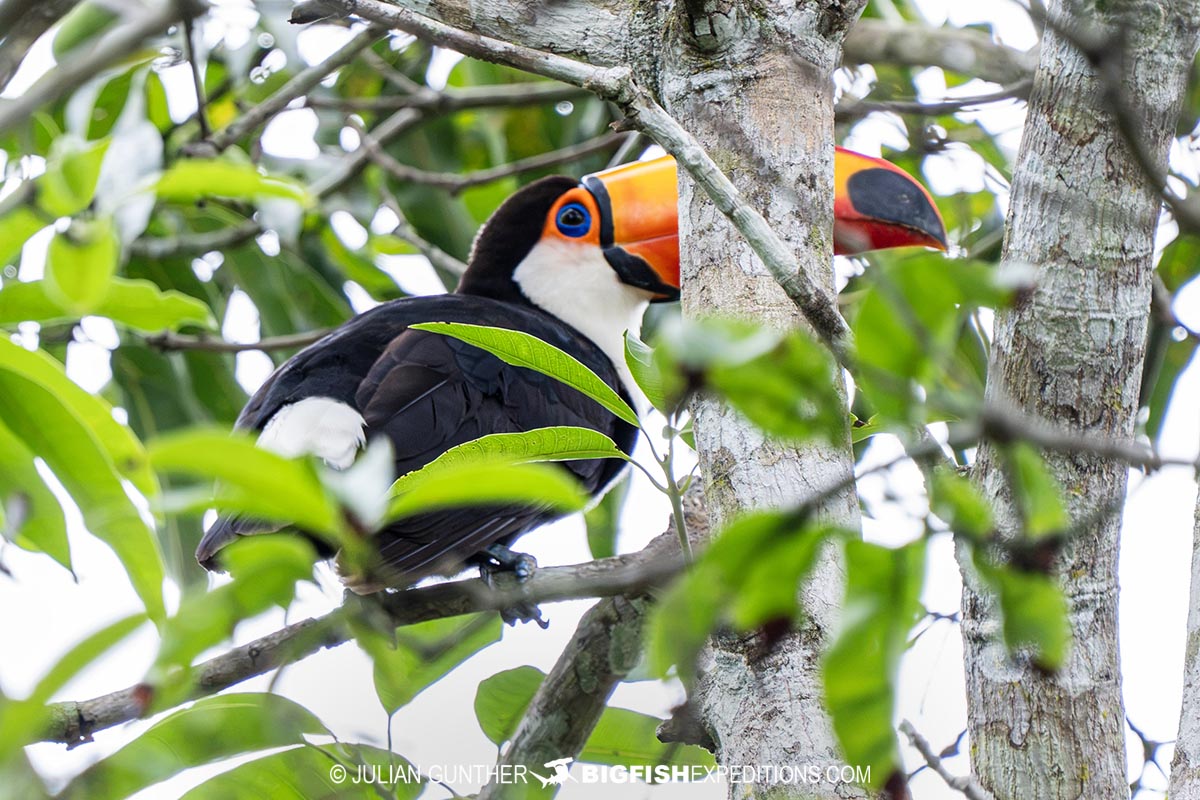
Conditions took a decidedly worse turn on day four, with rain starting late the night before and lingering off and on throughout the day. We tried our best, but snakes—much like people—prefer to stay sheltered when the weather sours. We exited that day at the Porto da Ilha Ecopark, a small island resort near a bend in the river where we managed to photograph a few resilient birds and an Argentine Black and White Tegu, a large lizard endemic to South America.
If day four’s weather was unfavorable, day five was downright bad. Although the trip ended in the rain, the opening days delivered some of the most successful encounters we’ve experienced in years of running these expeditions. Beyond the classic nature photography of anacondas and caimans, our guests also went home with incredible images of themselves in proximity of the animals—guaranteed talking points and memories to last a lifetime.
Join us next season in rivers of Brazil and scuba dive with the largest snake in the world!
Find out more: Anaconda Diving Tour